A battery-swap system is usually drawn as one battery and one charger. On the bench it is three connection points with three different jobs, and the connectors that fit one are wrong for the next two.
The distinction is not about quality. It is about what each joint has to survive: current, water, and the number of times a hand will touch it in a week.
Inside the pack: high current, no water, no human
The joint from the cells to the pack terminals carries the whole load — 45 A to 350 A depending on the model in the QS range — and it is mated once at assembly. It never sees rain, and nobody unplugs it in the field.
That is why the QS family, 76 models in this catalog, publishes no ingress rating on most of its parts. It is also why anti-spark sequencing exists there: on a 300 A pack with a large inverter capacitance, the inrush is real, and a ground contact that engages first carries it instead of an arc at the live contact.
Cabinet to pack: sealed, keyed, and touched every day
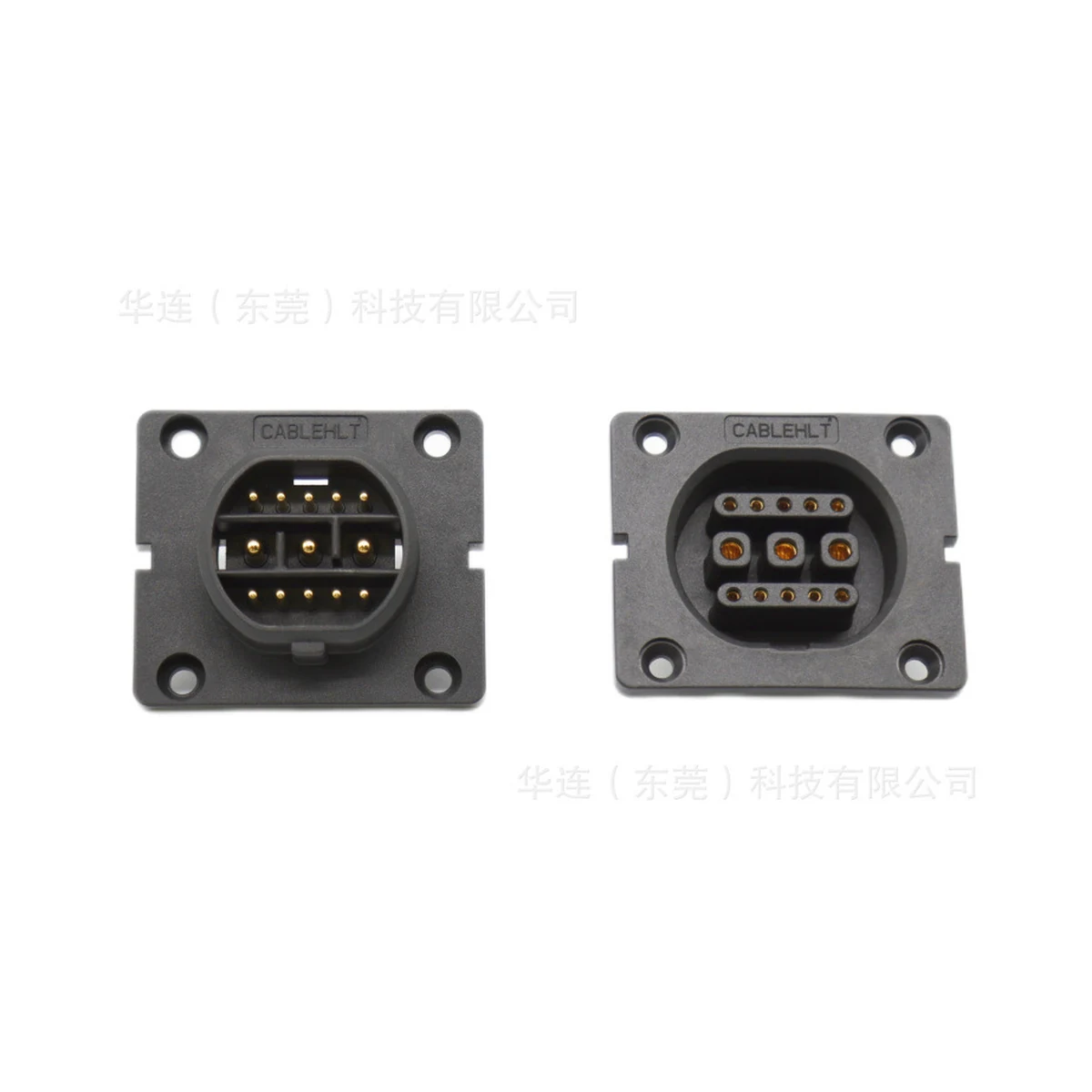
The second joint is the one a driver or a technician operates. It carries pack current plus whatever the station needs to talk about — temperature, state of charge, lock status. That is what the 3+10 range is for: four models, all IP67, rated 20–50 A continuous, UL94-V0 flame rated, gold-plated brass contacts, nylon housing, −40 to +120 °C.
The four parts cover the four mounting situations in a cabinet: a panel-mount socket, a socket, a plug, and a stackable plug-and-socket pair for cabinets that stack packs in series.
The e-bike box or swap station: a different contact set again
At the smaller end, the M25 2+1+5 carries eight contacts — two power, one earth, five signal — on a diamond-flange panel socket, with a silicone cover over the socket face when nothing is plugged in. The assembled panel socket weighs 20 g.
The sealing cover is the tell. A part designed to keep its rating while unmated has to assume the socket will sit open on a street corner between swipes of a card. A part designed to be mated once does not need that feature at all.
The three joints in one view
| Connection point | Connector | Contacts | Sealing | What decides the choice |
|---|---|---|---|---|
| Cells to pack terminal | QS high-current range | 2 (power plus ground) | None published — lives inside the pack | Rated current, anti-spark sequence, termination |
| Cabinet to pack | 3+10 range | Power plus signal in one shell | IP67 | Water on the joint, signal alongside power, mating cycles |
| E-bike box or station | M25 2+1+5 | 8 — 2 power, 1 earth, 5 signal | IP67 with sealing cover | Unmated exposure, small currents, panel space |
The mistake that costs money
It is using the inside-pack connector on the outside of the pack. A QS joint on a swap handle looks right in a CAD model — same current, same footprint, cheaper — and then the first month of rain finds the contact surfaces. Water in a 200 A joint does not fail gently; it corrodes, resistance climbs, and the pack starts reporting temperature faults that nobody can trace.
The reverse mistake is quieter: putting a sealed 20–50 A connector on a 250 A pack internal because it was already on the panel drawing. That one shows up as heat, not as water.
What to send for a quote
For a swap project the useful first email has four things:
- The three joints, drawn separately, with the current at each one
- Whether each joint is inside or outside the enclosure
- Signal count needed alongside power at the cabinet joint
- Mating cycles per day, and whether the socket sits open between uses