An IP code is two tests written as one string. The first digit is dust, the second is water. On sealed connectors the first digit is almost never the argument: a 6 means dust-tight, and anything sold as sealed either has it or is not sealed. Every disagreement between a buyer and a supplier in this range is about the second digit.
The second digit is not a score out of nine either. IPX7, IPX8 and IPX9K are three different test setups that answer three different questions. A part can pass 8 and fail 9K, and a part can pass 7 while carrying a claim of 8 that cannot be checked.
The three tests, side by side
IEC 60529 defines the conditions. The wording matters more than the number: 7 is a fixed test, 8 is a negotiated test, and 9K is a different kind of stress altogether.
| Rating | Test condition | What it proves | What it does not prove |
|---|---|---|---|
| IPX7 | Immersion at 1 m for 30 minutes, still water | Survives a dropped part, a flooded tray, a wash-down splash | Repeated cycles, pressure jetting, steam, anything deeper than a metre |
| IPX8 | Continuous immersion — depth and duration agreed between maker and buyer | Survives immersion at the depth and time stated on the report | Anything beyond the agreed depth or time; the figure is not comparable across suppliers |
| IPX9K | High-pressure, high-temperature water jet at close range | Survives steam cleaning and food-line wash-down | Immersion at all — a 9K part is not automatically a 7 part |
IP68 is the only one with no fixed condition
This is the part buyers miss. IPX7 is defined: one metre, thirty minutes, done. IPX9K is defined: hot water at high pressure, from close range. IPX8 is written as "continuous immersion under conditions agreed between manufacturer and purchaser" — which means the rating is only meaningful if the report states the depth and duration.
So two parts can both be IP68 while one was tested to 1.5 m for 24 hours and the other to 10 m for one hour. Neither is lying. They are simply not the same part, and a listing that says "IP68" with no condition behind it gives a buyer nothing to check.
For most of what this catalog is used for — a battery box under an e-bike, a junction under a machine guard, a swap cabinet at a roadside station — IP67 with a properly compressed gasket is a tighter, more honest specification than an unqualified IP68.
Where a connector actually loses its rating
Almost never at the moulded body. The failures come from the four places the sealing has to transfer through:
- The panel cut-out. A flange gasket only seals if the panel is flat and the screws are torqued evenly. A powder-coated panel with a burr at the hole will leak at IP67 and pass a bench test on a flat plate.
- The cable entry. A gland that is correct for 6 mm cable leaks on 4 mm cable. Overmoulded leads remove the variable; field-terminated glands move it to the installer.
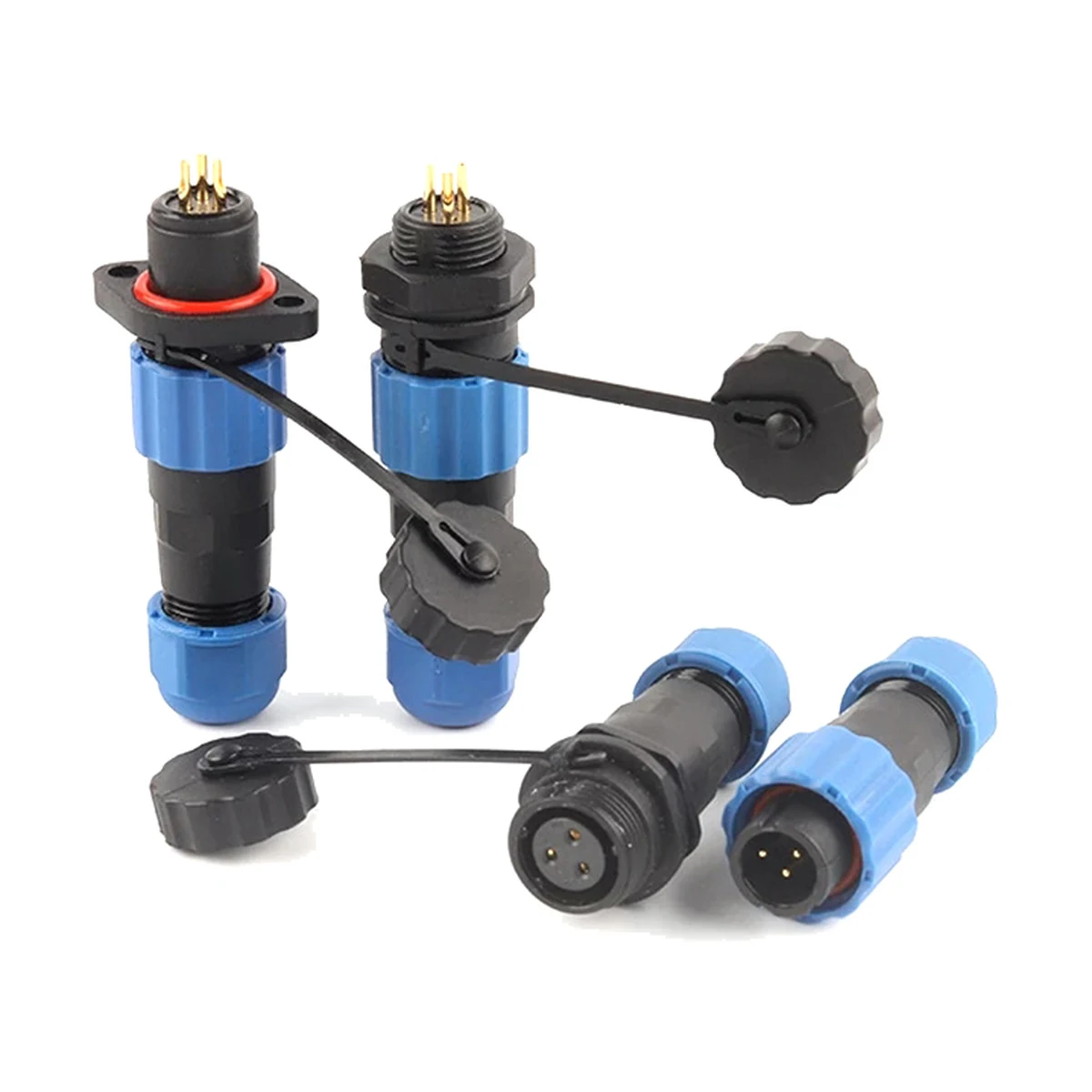
- The mating face, unmated. Two sealed halves are sealed together. A socket with an open face needs a cap, and the cap has to stay attached or it will be lost on the first service visit.
- The O-ring material over time. Nitrile hardens in UV and ozone, silicone stays flexible but swells in some oils. A part that passes at 20 °C can fail at −20 °C when the elastomer shrinks away from the groove.
What the 213 models in this catalog publish
Counted by model, not by variant, and straight from the specification rows on each page:
| Published rating | Models | Where they sit |
|---|---|---|
| IP68 | 28 | SP aviation family, both inline and panel-mounted |
| IP67 | 70 | Waterproof power connectors, 3+10 swap parts, M-series panel sockets |
| IP65 | 5 | Part of the QS10 high-current range |
| Lower or conditional | 11 | IP52, IP40, IP30, IP20 — indoor and dry assemblies |
| No rating published | 99 | Mostly QS anti-spark parts that live inside a sealed pack |
The last line is the one to notice. A QS anti-spark connector is not a sealed connector and is not sold as one. It sits inside a battery pack that is itself sealed. Reading "no rating" as "bad part" is the wrong conclusion; putting an unrated part on the outside of the pack is.
How to ask for the evidence
A rating is a claim until the test report arrives. Four questions settle it:
- What depth and duration was IP68 tested to, and is that on the report?
- Was the part tested mated or unmated, with a cap or without?
- What elastomer is in the seal, and what is the operating temperature on the same page?
- Does the panel cut-out drawing include the gasket compression, or only the hole size?