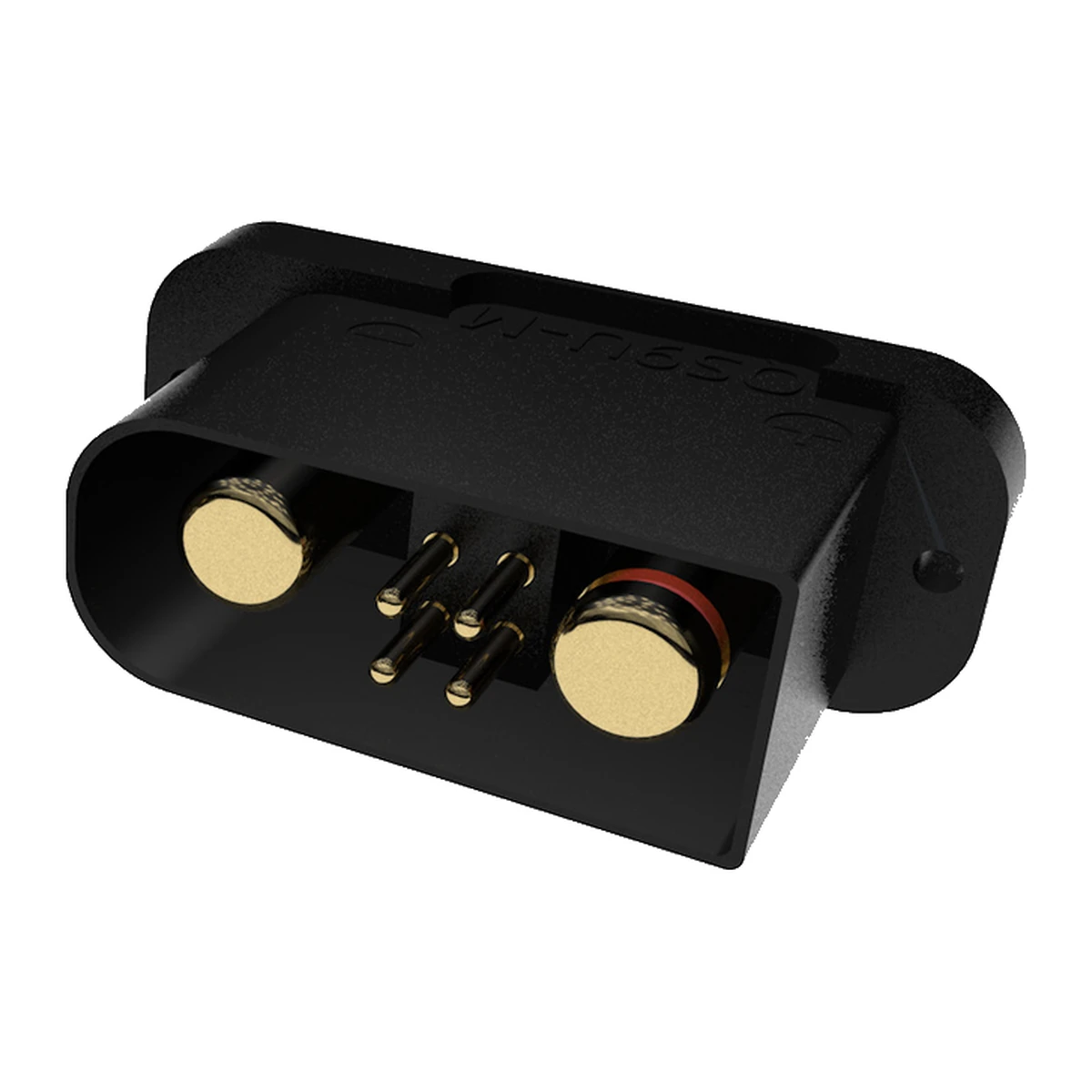
A battery connector is chosen by three numbers: current, voltage and whether the joint is allowed to get wet. Only the first of those is printed on the outside of the part, and even then not reliably.
In this catalog the QS family is 76 models. Within it, the published rated current runs from 45 A to 350 A — and the spread inside a single series is wider than the gap between series. That is why "send me a QS8" produces a quotation the buyer did not expect.
The spread inside the labels
Published rated current, counted across the models that state one:
| Series | Rated current | Rated voltage | Models in catalog |
|---|---|---|---|
| QS8 | 45 A – 350 A | not published on most models | 28 |
| QS9 | 110 A – 220 A | 500 V | 20 |
| QS10 | 210 A – 300 A | DC 500 V | 14 |
| QS12 | 250 A | AC 125 V | 2 |
| QS13 | 300 A | not published on most models | 3 |
A 45 A QS8 and a 350 A QS8 are the same family name and the same mating style, and they are not interchangeable in a pack. When a drawing or a BOM says "QS8" with no current, the specification is incomplete — the model number is what carries the rating.
The published figure is a rated current, not a peak
A number on a page is a steady-state rating under the conditions the maker tested. Two things move it in service: ambient temperature and the cross-section of the cable crimped or soldered into the contact.
A 300 A connector in a 25 °C cabinet and the same connector in an 85 °C enclosure beside a controller are two different applications. Before committing, ask for the derating basis — the ambient the rating assumes and how the figure falls as temperature rises. If a supplier cannot state the ambient behind the number, the number is decoration.
Sealing does not improve with current
It is tempting to assume the bigger the connector the more sealed it is. In this catalog the opposite shows up: the five models that publish IP65 sit in the QS10 range, while most QS8, QS9 and QS13 models publish no ingress rating at all.
The reason is application, not engineering. A QS part is designed to live inside a pack, behind the pack lid, where water never arrives. If your joint is outside the enclosure — a swap handle, an exposed busbar, a pack that sits under a seat — sealing decides the part before 40 A of headroom does, and that points at the M-series or the 3+10 parts instead.
Termination and plating
Two rows on the specification table carry more weight than they look:
- Termination. The QS8 range is soldered. Soldered joints are reliable when the operator is, and a cold joint on a 200 A contact is a thermal failure waiting for its first full-load cycle. Ask what the process control is, not just the termination type.
- Plating. Gold-plated copper contacts are published across the high-current ranges. Gold earns its cost where the joint sees many mating cycles or a corrosive atmosphere; on a joint mated once at assembly, bare copper with a correct crimp is not automatically worse.
Anti-spark is a contact sequence, not a feature of the range
Where a model is described as anti-spark, the ground contact engages before the power contacts, so the inrush current of a capacitor bank is carried by the ground path rather than by an arc at the live contact. It matters on a 300 A pack with a large inverter capacitance.
It is not on every QS model. If your BMS already runs a pre-charge resistor, the sequence is doing the same job twice; if nothing does, the sequence is the cheaper of the two solutions.
What to put in a quote request
One email with these six lines gets an accurate price in one round instead of three:
- Continuous current and system voltage, not just the series name
- Ambient temperature at the connector, and whether the joint sits inside or outside the enclosure
- Termination: soldered, crimped, or a specific cable cross-section
- Mating cycles expected over the life of the product
- Whether a pre-charge or anti-spark sequence is needed
- Quantity per model — pricing is per model, at a 50-piece minimum